Parlez-vous français ? → Visitez notre page en français !
Sprichst du Deutsch? → Zu unserer deutschen Seite!
Hanfmuseum: Ruth has stuck with it for 30 years
I can't remember when I first met Ruth. Maybe at one of our spring festivals in the mid-1990s? Ever since then, I've gone every year to the Hemp Museum in Mellingen – or, after it moved, to Tägerig, where the Hemp Museum is located today.
It was always a journey of self-discovery as well – exploring my activities, growing older, reflecting on the state of the hemp scene, and thinking about how we could better advocate for our cause. Most of the time, I took the train to Mellingen-Heitersberg, then the PostBus down into the Reuss Valley to Mellingen or back up a bit to Tägerig.
I've also walked from the train station quite a few times. It takes me three-quarters of an hour to get there.
When you take a trip every year, it becomes a bit of a ritual. You realize: Another year has gone by. I remember what went well and what wasn’t possible. I’m always really happy to discuss these topics with Ruth again. On July 1, 2026, it was that time again: an appointment at the Hemp Museum!
Sven: We're here with you, Ruth Zwahlen, at your hemp museum. How did the museum get started?
Ruth: In the mid-1990s, I ran a secondhand shop in Mellingen. Someone told me about hemp fields in the area. At first I ignored it – that couldn’t be true; after all, hemp is strictly prohibited. But then, a few days later, a hemp farmer called and asked if I would sell hemp products in my shop. He had hemp bath products, soap, tea, and honey for sale.
I felt that Brocki and hemp were a perfect match. Because both are, so to speak, traditional products: Hemp is, after all, an ancient plant that has been used for millennia.
In April 1996, I set up the storefront display with hemp products, and the next day I actually went to work with my knees shaking: after all, hemp wasn’t exactly on everyone’s lips yet. But people responded very positively. I knew that hemp (or at least part of it) had been banned since 1951 and that many people had been persecuted and even sent to prison. After all, the common belief had always been: “It’s something really dangerous – it’ll kill you!”
So I thought, “Now I finally want to explore this on my own,” and since then I’ve collected every newspaper article I could find, built up an archive, and bought books – whatever I could get my hands on.
But didn't it actually start with the hemp products at the Brocki?
Yeah, and then it just kept expanding more and more…
You've been running the Hemp Museum for 30 years now. How have you managed to stick with it for so long?
Perseverance! And because I find the way hemp is treated – the ban and the prosecution – totally unfair. It’s enough to drive you crazy! Hemp is such a gentle, lovely plant. It grows almost everywhere in the world, yet it’s so maligned. That’s why I’ve kept going, even under the most difficult circumstances.
For me, the entire history of the persecution of hemp is linked to some very painful experiences. Many people have suffered under this miserable cannabis prohibition law; they were fined, sent to prison, lost their jobs, and some even lost their lives. There are so many incredibly sad stories!
I also joined various clubs back then, such as the Association Legalize it!
That was back in the '90s, wasn't it?
That’s right. Back then there were the Aargau hemp producers and DroLeg, and in 1998 there was also a vote on the popular initiative “For a Sensible Drug Policy,” which was unfortunately rejected. There were also countless hemp shops throughout Switzerland, many of which were members of the Swiss Hemp Coordination.
Starting in 2000, I stopped running the Brocki and focused on the archive and museum: simply raising awareness about hemp.
Since then, quite a bit has accumulated there: over 500 books, more than 300 folders on hemp and politics, 36 folders containing letters to government agencies (and their replies), 44 photo albums, and 11 guest books. I’ve also received private files on the subject from many people, as well as archives from organizations that no longer exist.
In addition, there is the museum itself with its exhibits: food, cosmetics, tea, soap, beverages, medicine, paper, shoes, clothing, ropes, spinning wheels, hemp breakers, rope-making wheels, and much more – all made of hemp, containing hemp, or used for processing hemp.
So how much longer are you going to keep doing this?
I’m thinking back over the past 30 years… Okay, so that’s a joke. I’m 77 now, after all. What was also kind of funny: those headlines over and over again like “Smoking weed will be legal,” “Hemp to be legalized soon,” and so on. All those decades, over and over – but so far, it hasn’t become a reality.
Just how many people have always been happy to help you with this work?
Many people have donated exhibits to the museum, while others have sent me information for the archives. I would like to thank everyone for that!
Then there’s my family. It’s not like they actually run the museum. But just having the patience with me – that alone means the world to me; I really have to say that. Because, well, the museum has kind of “spread out” a bit. We practically live in the museum here.
Looking around, it seems like you're not quite keeping up with the work?
Not at all, not in the least. Yes, you have to do as much as you can. Otherwise, I would have had to quit a long time ago.
But what happens if you don't want to or can't anymore? What happens then?
I don't know. So far, I haven't found a solution. Actually, this really should be archived by the government. It should have an official place where it can be stored. I think the museum will be important someday.
Many issues only gain significance after a few decades. Only then does an apology come (e.g., when the Yenish people had their children taken away, or in the cases of the “Verdingkinder” and those placed in administrative care). This injustice was accepted for a long time, until “people” finally realized that it was a felony crime against humanity. “It was just the spirit of the times,” people keep saying. But over time, this “spirit of the times” really gets on your nerves. Put an end to the cannabis ban once and for all!!!
Sven's entry in the guestbook dated July 1, 2026:
30 Years of the Hanfmuseum!
It's been a long time: Great that you've stuck with it. We haven’t reached our goal yet, but at least we’ve got fixed penalty for recreational use, a legal limit of 10 grams, prescription cannabis, pilot projects (…) Hang in there, enjoy yourself, and keep going, says someone who’s been at it for over 35 years.
Sven, Association Legalize it!
Links to additional information: Hemp Museum
History of the Hemp Ban
In addition to her hemp museum and archive, Ruth also contributed to the publication of the book The Never-Discussed History Behind the Hemp Ban. It is very important to her that this book reach a wider audience, which is why we are happy to highlight it here once again.
 |
Nachtschatten Verlag, 200 pages
ISBN 978-3-03788-635-9, 19.80 CHF
ISBN 978-3-03788-660-1, 14.00 CHF (e-book)
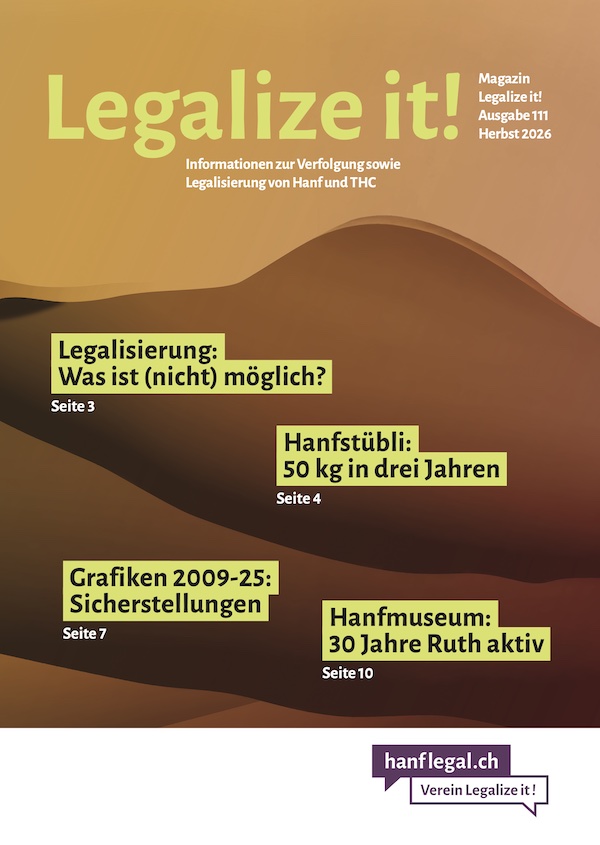
Magazine Legalize it! #111
Unfortunately, this magazine is only available in German.
Become a member and receive all issues!
Support our work with a donation:
Bank transfer
Account number (IBAN):
CH02 0900 0000 8709 1354 3
Full account details
Or scan this QR code with your eBanking App (ZKB, Revolut, Postfinance, …):

Or open/share the QR code as PDF file with your eBanking App.
Credit card


Donate via credit card
TWINT

Donate via TWINT
Verein Legalize it!
Quellenstrasse 25
8005 Zürich
Threema ID 7NH65RBY


