Parlez-vous français ? → Visitez notre page en français !
Sprichst du Deutsch? → Zu unserer deutschen Seite!
Three Years of Hanfstübli: A Hemp-Filled Experience
It was a special feeling to be allowed to legally sell hemp with more than 1% THC for the first time. After decades of dealing with illegality and repression, this was truly a step toward legality—not just in theory, but in practice!
Three years of legal sales
We began sales at the end of August 2023. However, this was preceded by a preparatory phase lasting several years: submitting a project proposal to the city, attending training sessions, searching for a location with dining facilities, waiting for approval from the BAG, and then finally receiving the first delivery.
50 kg of inspected goods
As of mid-July 2026, we have sold 50 kg—10,000 5-gram packets. Despite all the red tape and regulations that must be followed, it has been and continues to be extremely interesting to see how legal trade can be structured in Switzerland.
Product sales at the Hanfstübli
August 2023 through June 2026
 |
A colorful group
Our Association now has just under 150 active members. Our members come from all walks of life: from students to working professionals to retirees. Participants range in age from 23 to 70; the average age is 42. Some are no longer participating; the most common reason is moving out of the city of Zurich, which automatically ends their participation in the study.
Elaborate shots
Since our project is a scientific study, recruiting new members involves a great deal of effort. Thank you to Sonia for conducting all those countless intake interviews over the years!
Preparing for a Shift
Upon arrival at the Hanfstübli, each shift begins (and ends) with a quick inventory check: We print the inventory list on the computer and check that the safe contains the correct number of packages of the various types of weed / hashish in the sales boxes and storage nets. This ensures that any errors can be quickly identified and promptly corrected by our five-person sales team without disrupting the workflow.
In the Züri Can project, study participants are permanently barred from the study if they do not complete the semiannual questionnaire by the deadline. Therefore, before each pickup appointment, we check whether the deadline is approaching (since we know who is coming—we work with advance reservations) and notify members both in writing and verbally.
Here we go: We welcome members as they arrive, and they enter the Stübli one by one. If it gets crowded, they take a seat outside. Depending on the situation, we provide advice or answer questions.
The Actual Sale
The member’s ID is scanned, the package(s) are removed from the boxes, and these are also scanned (barcode and QR code). Next, the correct batch (lot) must be selected, and by clicking “Payment Successful,” the sale is completed and the merchandise is handed over to the member. From time to time, an inventory check ensures that everything is correct.
We generally take the time to chat or answer questions, but most members have to leave—though some linger on the patio. Every now and then, we have to check that everything is in order out there: empty ashtrays, adjust the umbrella, and, if necessary, set up wind and rain protection for the ashtrays and papers.
We also rent out vaporizers, which can be booked through our online store and are cleaned by us after they are returned.
If the sale day is slowly coming to an end and we have some time, we’ll quickly contact members with pending orders to find out if they’ll still be coming by, or if they’d like to reschedule pickup or cancel their order.
After the shift
Once the sale is over, the same process takes place as at the beginning—only in reverse: First, put the sales boxes back in the safe (and restock them if necessary for the next shift) and bring everything back inside from the patio.
On Saturdays, we usually have more time than during the shorter shifts during the week. When things are slow, we have time to vacuum or dust, collect and empty the trash, and bundle and dispose of cardboard and paper.
After one last check—including the patio—it’s time to call it a day. Our club meeting takes place every two weeks as scheduled—that’s all part of it!
Don't make any mistakes!
Even with a permit: These are controlled substances. Everything has to be checked; everything has to be correct. If anything is missing, a loss report must be filed. So we try to handle everything with precision. Given that we had only a handful of errors out of over 10,000 bags, we’ve largely succeeded in doing so!
Long lead times and high requirements
Not only the distribution points (such as our Social Club), but also the hemp producers are subject to strict regulations. Under Switzerland’s “Track & Trace” system, every hemp plant is carefully tracked from the seeds all the way to the finished flower. Every batch of the finished product must be tested in a laboratory for contaminants and THC content. Only after the study director, the producer, and the FOPH have all approved a crop can we place an order for the product.
Only gradual adjustments
This lengthy process is the reason for a relatively fixed product lineup with little change compared to the black market. On the one hand, stability is certainly good for consumers, because only when quality and availability remain consistent can participants truly “get to know” a strain. On the other hand, it must be noted: The high and often unusual requirements set by the study’s administrators (e.g., a strain with 5% THC and 10% CBD content) unfortunately mean that some strains still haven’t been approved even after years, and there are repeated delays and complications. Nevertheless, we greatly appreciate the opportunity to gain concrete experience with this legal sales model!
Link to more information: hanfstueb.li
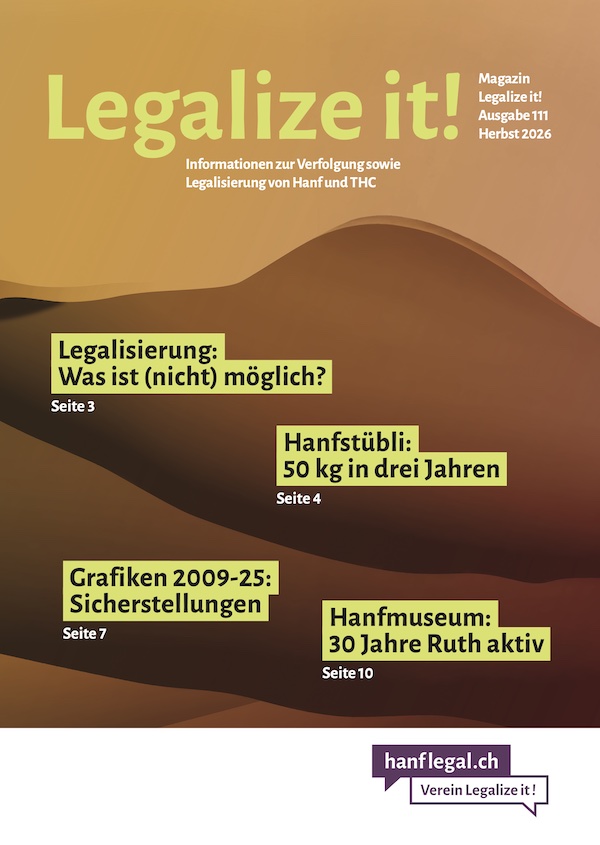
Magazine Legalize it! #111
Unfortunately, this magazine is only available in German.
Become a member and receive all issues!
Support our work with a donation:
Bank transfer
Account number (IBAN):
CH02 0900 0000 8709 1354 3
Full account details
Or scan this QR code with your eBanking App (ZKB, Revolut, Postfinance, …):

Or open/share the QR code as PDF file with your eBanking App.
Credit card


Donate via credit card
TWINT

Donate via TWINT
Verein Legalize it!
Quellenstrasse 25
8005 Zürich
Threema ID 7NH65RBY


