Parlez-vous français ? → Visitez notre page en français !
Sprichst du Deutsch? → Zu unserer deutschen Seite!
Hemp Needs a Stance: Why We Want to Give the Plant Back Its Place in Society
Hemp is one of the most versatile crops and useful plants in existence. Yet hardly any other plant has been so profoundly shaped by bans, prejudice, and social stigma over the decades.
Prohibition has not only influenced how cannabis is treated under the law; it has also changed the way people talk about and think about the plant. For a long time, the focus was primarily on intoxication, illegality, and criminal prosecution, rather than on agriculture, culture, genetic diversity, sustainability, or processing.
Here at Herba di Berna, we want to help broaden this perspective once again. Not by romanticizing or glorifying cannabis, but by showing that a responsible approach to hemp also involves knowledge, quality, sustainable production, and honest communication.
After all, our true goal goes far beyond simply selling hemp products: We want to restore cannabis – both as a cultural and a crop plant – to the place in society that it deserves.
How Prohibition Shaped the Image of Hemp
When people talk about cannabis today, they often start by discussing THC, legal limits, bans, or legalization. This is understandable, since for decades, public perception of the plant has been shaped precisely by these issues.
In the process, many other factors took a back seat. How do different strains differ? What influence do soil, climate, and cultivation methods have? What happens after the harvest, and why do drying, processing, and storage sometimes differ significantly? The question of how a hemp plant can be used as sensibly and completely as possible also played hardly any role in public discussion for a long time.
These are issues that deserve to be discussed more openly again today. After all, a new societal perspective on cannabis doesn’t arise simply because laws change. It also arises as we learn to view the plant in a more nuanced way once again.
That is precisely where we see one of our responsibilities.
Why Herba di Berna Exists in the First Place
Herba di Berna wasn't born out of the idea of simply setting up yet another Swiss CBD shop. Rather, it all began with a passion for a plant whose potential and cultural significance, in our opinion, have been reduced far too much to isolated aspects over the decades.
This led us to ask how we ourselves could help ensure that hemp is once again viewed in a more objective and matter-of-fact manner. Our answer was to bring together as many areas as possible: production and processing, expertise and quality control, direct interaction with people, and open and transparent communication.
Today, we work with select producers, operate a specialty store in Bern, and reach people throughout Switzerland via our digital channels. The core of our work has remained the same:
We want to show that responsible and sustainable hemp cultivation is possible.
A corporation, but not for-profit
Our corporate structure also reflects this philosophy. Herba di Berna is a corporation, yet we are deliberately not profit-oriented.
Of course, we, too, must operate on a sound financial footing. We pay wages, invest in production, develop products, and must be able to survive as a business in the long term. For us, however, the key issue is the role that the mere pursuit of profit maximization plays in these decisions.
Economic success should enable us to continue and further develop our work over the long term. However, for us, it is not the sole purpose of our company. We want to create structures that also take into account our responsibility toward our employees, customers, the environment, and hemp culture.
We make many decisions together as a team. We consciously invest in people, production quality, and sustainable structures, and we try not to judge business decisions solely based on where the highest short-term margins can be achieved.
We believe this approach is particularly important in the cannabis industry. If we call for a more responsible approach to cannabis in society, we must first and foremost hold ourselves to that standard.
For us, sustainability starts with the soil
Sustainability is a term that’s thrown around a lot these days. For us, therefore, it’s not enough to simply print it on packaging or include it in a product description. Sustainability must be reflected in the way we manufacture our products and make decisions.
One example of this is farming. The plants grow in organic, living soil. Under the so-called “living soil” principle, the soil is not simply viewed as a medium, but as a living ecosystem. Microorganisms, worm cultures, and organic matter help build and maintain the soil structure over the long term.
As sustainable producers, we avoid using artificial fertilizers and rely on natural beneficial insects for pest control. When it comes to energy consumption, we should also consistently rely on electricity from renewable energy sources.
These may not be spectacular headlines. But for us, it is precisely these kinds of decisions that define credible sustainability. It doesn’t start with marketing – it starts with production.
Good quality begins long before the product is packaged
With cannabis, quality isn't determined solely by the final product. It begins with the selection of the genetics and continues throughout the entire production process.
Soil and nutrient supply, climate and plant care, harvest timing, drying, processing, and storage can all influence the final product. That is why we view quality not as a single step, but as a process.
We have many years of experience in the cultivation and processing of cannabis. Nevertheless, we do not rely solely on experience. Production processes are regularly monitored and supplemented by external laboratory analyses.
That’s why, especially when it comes to CBD flowers, we believe that origin, cultivation methods, processing, and quality control are inextricably linked. After all, trust isn’t built simply because a company claims to offer high quality. Quality must be verifiable.
The entire plant deserves appreciation
Another important part of our philosophy is the responsible use of resources. A high-quality hemp plant does not consist solely of the largest and most visually appealing flowers.
During processing, small flower parts and flower trimmings are produced. These parts also come from the same carefully cultivated plant. Simply discarding them – even though they can be put to good use – goes against our understanding of sustainable production.
That's why we try to use the plant as holistically as possible. For example, anyone looking to buy CBD trimmings will find carefully collected flower trimmings here – the parts that fall off when the flowers are turned during the drying process.
For us, this isn't just about a single product. Behind it lies a fundamental question: How do we manage the resources that a plant provides us? When we talk about sustainability, this question is an essential part of the discussion for us.
Responsibility doesn't end with the product
A responsible hemp market requires more than just good production. It also requires good, reliable information.
When it comes to cannabis in particular, scientific findings, personal experiences, decades-old prejudices, and – in some cases – very aggressive marketing all come into play. This can quickly lead to expectations that have little to do with reality.
That is why, for us, honest communication is just as much a part of quality as the cultivation process itself. We want to explain where products come from, how they’re made, what distinguishes different quality levels, and how various cultivation and processing methods work. It’s equally important to provide a clear context for legal frameworks and to clearly communicate the limits of reliable claims.
This explicitly includes not promising effects that cannot be reliably substantiated. Hemp doesn’t need miracle claims – it’s a wonderful plant even without them. If we want society to take cannabis seriously, those who work with cannabis must also speak about it responsibly.
For us, education is not a side project
For this reason, our communications have long since moved beyond focusing exclusively on our products. We address political developments, examine scientific publications, and explain the various ways in which cannabis is becoming established in the medical field.
We also cover pilot projects, regulatory changes, and public discussions surrounding cannabis. We aim to present complex topics in a way that makes them accessible even to people who have had little exposure to cannabis so far.
Our point is not that everyone has to share our point of view. Rather, our goal is for discussions to be based on information, not solely on decades-old prejudices.
This is precisely where we also see a strong connection to the work of Legalize it!.
Educational Work on Cannabis Brings People Together
It is precisely in the area of public education that we see a particularly strong connection between Legalize it! and Herba di Berna. For decades, the Association has been tracking political and legal developments surrounding cannabis in Switzerland, documenting repression and legislation, and making extensive knowledge publicly available.
At Herba di Berna, too, education has long been a central part of our work. For years, our blog has addressed scientific, social, and political topics related to hemp and cannabis. These include research and the endocannabinoid system, as well as the black market, youth protection, pilot projects, legalization, and current developments in Swiss cannabis policy.
Today, Dominic Berg, Marketing and Content Manager at Herba di Berna, is responsible for a large part of this editorial work. In addition to his other responsibilities at the company, he regularly researches and writes our expert and in-depth articles, striving to present even complex topics in a clear and nuanced way.
Legalize it! and Herba di Berna approach the issue from different perspectives, but they share a common conviction: A responsible cannabis policy requires a well-informed society.
That is precisely why we believe the exchange between a Association such as Legalize it! and companies in the Swiss hemp industry is so valuable. Knowledge, political experience, practical industry expertise, and direct engagement with the community can complement one another and, together, reach more people.
Legalization alone does not create a healthy cannabis culture
The political debate surrounding cannabis has evolved significantly in Switzerland in recent years. Scientific pilot projects are gathering practical experience with regulated cannabis distribution, while discussions are underway in parallel about what a future legal framework might look like.
We welcome this development. At the same time, we believe that changing the law can only be part of the solution.
A responsible cannabis and hemp market requires transparent production chains, clear quality standards, and traceable controls. Equally important are responsible suppliers, objective consumer information, sustainable production models, and, above all, realistic protections for youth and consumers.
After all, legality alone says nothing about quality or responsibility. Even a legal market must be shaped. That is precisely why the experiences that producers, associations, researchers, government agencies, pilot projects, and consumers are already gaining today are so important.
Hemp cultivation also means respecting the plant
We love hemp. But that doesn't mean we idealize the plant. On the contrary: Anyone who truly respects a plant should also be able to talk about it in a nuanced way.
This includes both high- and low-quality products, sustainable and less sustainable production methods, as well as positive and problematic developments. Social opportunities and the responsibilities that come with them must also be part of an open discussion.
A credible cannabis culture requires precisely this distinction. After decades of prohibition, one of the most important changes may be to stop either demonizing or glorifying cannabis exclusively.
We can start talking about it in a normal, objective, and open way.
What We Hope for in the Future
We hope for a Switzerland where hemp is not automatically viewed through the lens of decades of prohibition, but where people can discuss cannabis objectively and with nuance.
For us, this includes a hemp industry in which producers take responsibility for their products, consumers receive transparent information, and quality and sustainability are prioritized over aggressive marketing.
We would like to see an approach to cannabis that is shaped neither by outdated prejudices nor by exaggerated promises. Instead, the plant should once again be viewed in a nuanced way: as a cultivated plant, a crop, an agricultural product, and a part of our social reality.
At Herba di Berna, we want to be part of this effort – through organic farming, sustainable production, verifiable quality standards, expertise, and transparent communication. At the same time, we believe it’s important to continually take a critical look at our own industry.
Because one thing hasn't changed since we were founded:
We want to restore the cannabis plant – both as a cultural and a crop plant – to its rightful place in society.
Sources and Further Information
Herba di Berna AG – About Us
Corporate Philosophy, Sustainability, Production, and Commitment to Quality
Magazine Legalize it! #111
Unfortunately, this magazine is only available in German.
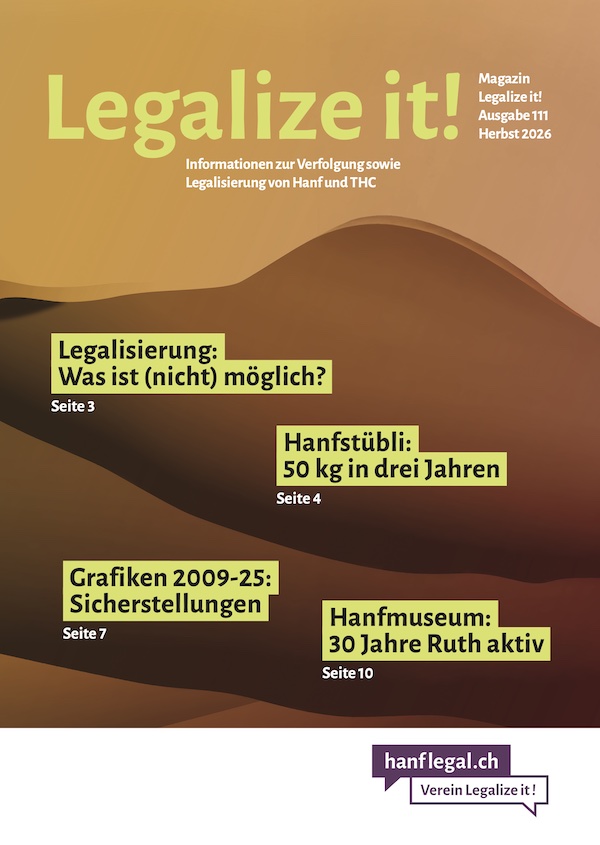
Become a member and receive all issues!
Support our work with a donation:
Bank transfer
Account number (IBAN):
CH02 0900 0000 8709 1354 3
Full account details
Or scan this QR code with your eBanking App (ZKB, Revolut, Postfinance, …):

Or open/share the QR code as PDF file with your eBanking App.
Credit card


Donate via credit card
TWINT

Donate via TWINT
Verein Legalize it!
Quellenstrasse 25
8005 Zürich
Threema ID 7NH65RBY